Support our educational content for free when you purchase through links on our site. Learn more
What Is the Format for a Play Script? 🎭 Your Ultimate 2026 Guide

Have you ever picked up a play script and wondered why it looks so different from a novel or a movie screenplay? Or maybe you’re a teacher or budding playwright staring at a blank page, unsure how to start formatting your masterpiece so it’s stage-ready. Well, you’re in the right place! At School Play Scripts™, we’ve helped countless educators and writers crack the code of play script formatting, turning chaotic drafts into polished gems that directors and actors love.
Here’s a little secret: the format of a play script isn’t just about aesthetics—it’s a powerful tool that helps everyone involved in a production understand the story clearly and efficiently. From the iconic Courier font to the way character names and stage directions are laid out, every detail has a purpose. Later in this article, we’ll reveal common pitfalls to avoid, share insider tips to make your script stand out, and even break down how professional software like Final Draft can save you hours of formatting headaches. Ready to make your script shine? Let’s dive in!
Key Takeaways
- Play scripts follow a standardized format featuring 12-point Courier font, centered character names in ALL CAPS, and italicized stage directions to ensure clarity and timing.
- Acts and scenes are clearly marked with centered headings to structure the play and guide production teams.
- Stage directions should be concise and sparingly used to allow actors creative freedom while providing essential guidance.
- Using dedicated scriptwriting software like Final Draft or Celtx can streamline formatting and boost professionalism.
- Avoid common mistakes such as inconsistent formatting, improper fonts, and over-directing to keep your script readable and production-friendly.
Table of Contents
- ⚡️ Quick Tips and Facts About Play Script Formatting
- 🎭 The Evolution of Play Script Formats: A Brief History
- 📋 What Is the Standard Format for a Play Script?
- 🖋️ How to Write a Play Script: Step-by-Step Formatting Guide
- 🎬 Play Script Formatting Examples: From Classic to Contemporary
- 🛠️ Essential Tools and Software for Formatting Play Scripts
- 📚 Common Mistakes to Avoid When Formatting Your Play Script
- 💡 Tips for Making Your Play Script Stand Out to Producers and Directors
- 🎭 Differences Between Play Script Formats and Screenplay Formats
- 🧑 🏫 Resources and Templates for Play Script Formatting
- 📖 Conclusion: Mastering the Art of Play Script Formatting
- 🔗 Recommended Links for Playwriting and Formatting
- ❓ Frequently Asked Questions About Play Script Format
- 📑 Reference Links and Further Reading
Here is the main body of the article, written according to your instructions.
⚡️ Quick Tips and Facts About Play Script Formatting
Welcome, aspiring playwrights and drama teachers! We’re the team at School Play Scripts™, and over the years, we’ve seen it all—from scripts scribbled on napkins to perfectly polished masterpieces. Before we dive deep into the nitty-gritty of play script format, let’s get you started with the essentials. Think of this as your backstage pass to looking like a pro from page one. And trust us, a well-formatted script is like a firm handshake; it makes a fantastic first impression. If you’re looking for inspiration on what a finished, hilarious script looks like, check out our list of 15 Hilarious Comedy School Play Scripts to Try in 2026 🎭.
Here’s a quick-reference table to keep on hand. Pin it up! Memorize it! It’s your new best friend.
| Feature | The Industry Standard | Why It Matters |
|---|---|---|
| Font | 12-point Courier or Courier New | A monospaced font, it ensures one page roughly equals one minute of stage time. It’s a tradition from the typewriter era that became essential for production timing! |
| Margins | 1 inch on all sides | Provides ample white space for directors, actors, and stage managers to scribble notes during rehearsals. Don’t be stingy with the space! |
| Page Numbers | Top right corner | Crucial for keeping everyone literally on the same page during read-throughs and rehearsals. The title page is page 0 (i.e., unnumbered). |
| Character Names | Centered and in ALL CAPS | Makes it easy for actors to spot their lines when scanning a page. No searching required! |
| Dialogue | Directly below the character’s name | This is the meat of your play. It should be left-aligned and easy to read. |
| Stage Directions | In parentheses and italicized | These are your instructions for action, tone, and movement. Keep them brief and impactful. |
| Act/Scene Headings | Centered, bold, or underlined | Clearly marks the structure of your play, signaling major shifts in time or location. (e.g., Act I, Scene 1) |
The bottom line? ✅ Consistency is key. A producer or director can tell within seconds if a writer knows the basic rules. Following these conventions shows you respect the craft and the people who will bring your story to life.
🎭 The Evolution of Play Script Formats: A Brief History
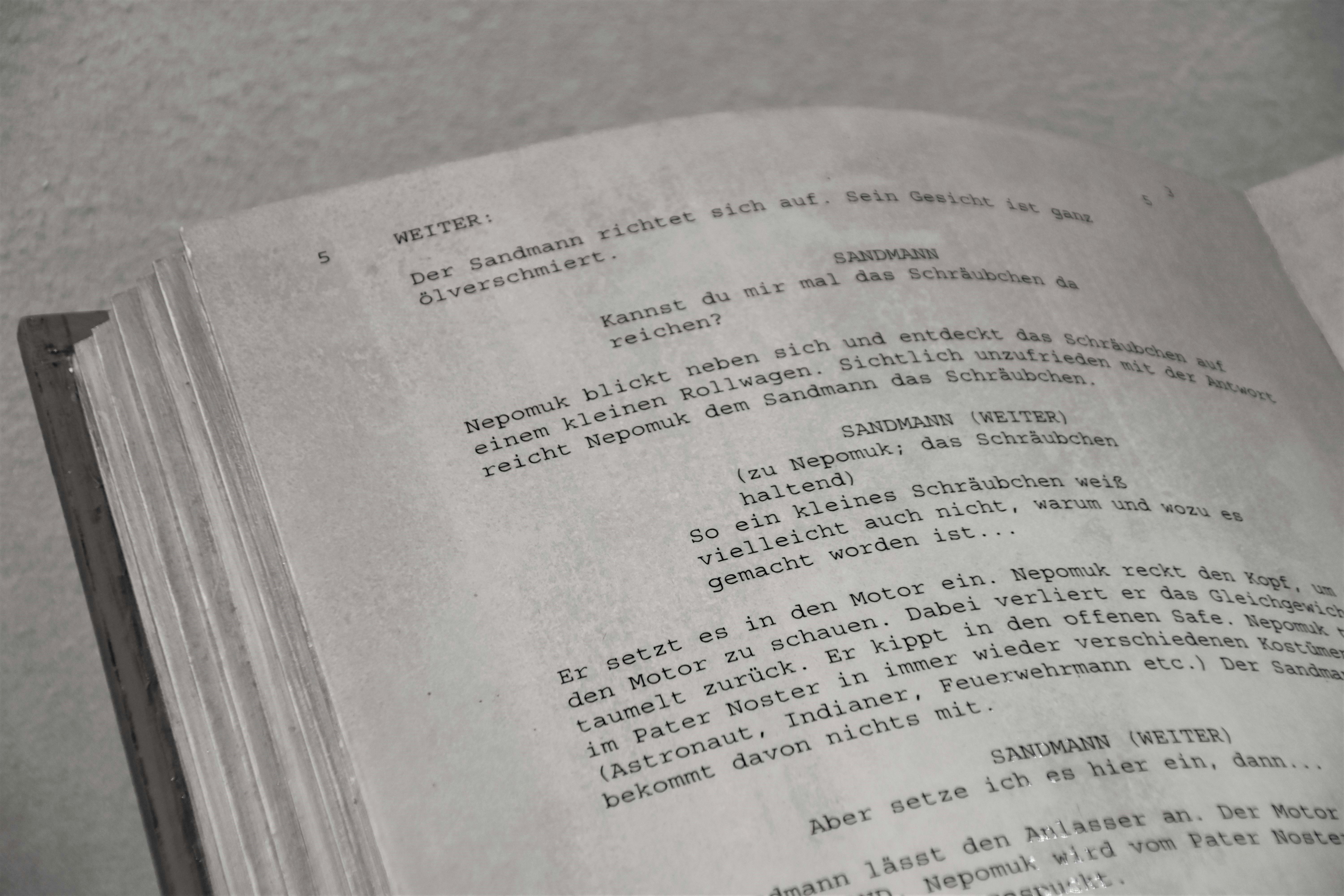
Ever wonder why we’re so particular about formatting? It wasn’t always this way! Let’s hop in our time machine and take a quick trip through the history of the humble play script.
Back in Shakespeare’s day, things were… chaotic. 😅 Scripts, known as “quartos,” were often transcribed by actors from memory, leading to wild inconsistencies. Stage directions were minimal, like the famously brief and debated “Exit, pursued by a bear.” There was no standard font, no specific margin size—just the words and the raw energy of the theatre. You can explore some of these early texts at the Folger Shakespeare Library to see for yourself!
The real game-changer was the typewriter. Suddenly, there was a tool that could create uniform text. The Courier font was born not for art, but for practicality. Because every character takes up the exact same amount of horizontal space (it’s “monospaced”), it allowed producers to accurately estimate a play’s run-time. This simple invention revolutionized production planning. As the experts at Tameri.com point out, “Script formats, as with manuscript formats, have evolved to help with the production of a work.” It’s not about being pretty; it’s about being functional.
Today, we have powerful software that does the heavy lifting, but the core principles established in the typewriter era remain. Why? Because they work. They create a universal language that every actor, director, and designer on a production team can understand instantly.
📋 What Is the Standard Format for a Play Script?
Alright, let’s break down the anatomy of a perfectly formatted play script. While some theatres or competitions might have their own “house style” (a point Scribendi rightly emphasizes), there is a widely accepted professional format. Mastering this will ensure your script is taken seriously wherever you send it.
Character Names and Dialogue: The Heartbeat of the Script
This is where your story comes alive. The interplay between who is speaking and what they say is the core of your play.
- Character Names: Always in ALL CAPS. They should be centered on the page above the dialogue. Some formats use a deep indent instead of centering, but centering is more common and, in our opinion, easier to read.
- Dialogue: This follows directly below the character’s name. It’s left-aligned and written in standard sentence case. There’s no need for quotation marks. The formatting itself tells us it’s spoken dialogue.
Here’s a simple example:
MS. APPLEBAUM
Class, please remember that your history projects are due tomorrow. No excuses. Not even if a dragon eats your homework.
TIMMY
But Ms. Applebaum, what if it was a really, really cool dragon?
See how clean that is? An actor can scan the page and find their lines in a heartbeat.
Stage Directions and Parentheticals: Guiding the Action
Stage directions are your way of communicating action, tone, and setting to the cast and crew. There are two main types:
-
Action Blocks: These describe broader actions, entrances, exits, and significant physical business. They are written in italics and are indented from the left margin. Character names within these blocks are capitalized.
TIMMY enters from stage left, dragging a massive, glitter-covered volcano model behind him. MS. APPLEBAUM raises an eyebrow, unimpressed.
-
Parentheticals (or Wrylies): These are short, specific directions for a line of dialogue. They appear in parentheses and italics on a separate line between the character’s name and the dialogue. They should be used sparingly! A good actor can often infer the tone from the dialogue itself. Overusing them can feel like you’re micromanaging the performance.
TIMMY
(*Nervously*)
It’s not late, is it?
✅ Do: Use them for essential actions or tones that aren’t obvious from the dialogue. ❌ Don’t: Use them to describe every little gesture or emotion. Let your actors act!
Scene Headings and Act Breaks: Structuring Your Play
These are the signposts of your play’s journey. They tell the reader where and when we are.
- Act Headings: Centered, often bolded or underlined, and written with Roman numerals (e.g., Act I). A new act always begins on a new page.
- Scene Headings: Also centered and bolded, but use Arabic numerals (e.g., Scene 1). A new scene does not necessarily need to start on a new page unless it’s the first scene of an act.
- Setting Description: Immediately following the scene heading, a brief, italicized description sets the stage.
Act I
Scene 1
A chaotic middle school classroom. Desks are askew, and posters of historical figures with googly eyes adorn the walls. MS. APPLEBAUM sits at her desk, looking weary.
This structure provides a clear, hierarchical framework for your story, making it easy for a production team to plan set changes, lighting cues, and costume adjustments.
🖋️ How to Write a Play Script: Step-by-Step Formatting Guide
Ready to format your masterpiece? Let’s walk through it, page by page. Don’t worry, it’s easier than it looks, especially if you’re using dedicated software.
-
The Title Page: This is your script’s business card. It should be clean and professional.
- Center your play’s TITLE IN ALL CAPS about a third of the way down the page.
- Beneath that, on a new line, center “By”.
- Beneath that, center your Name.
- In the bottom right or left corner, include your contact information (address, phone number, and email).
- Crucially: There is NO page number on the title page.
-
The Dramatis Personae (Character List): This is the next page.
- Title the page Dramatis Personae or Characters, centered.
- List each character’s name, left-aligned and in ALL CAPS.
- Follow the name with a brief, descriptive sentence about the character.
- Example:
TIMMY – An imaginative but perpetually late 12-year-old. MS. APPLEBAUM – A history teacher who has seen it all.
-
The Setting/Time Page: This page follows the character list.
- Center the heading SETTING. Below it, describe the overall setting of the play.
- Leave a few spaces, then center the heading TIME. Below it, describe the time period.
-
The First Page of the Play: Now the action begins!
- Start your page numbering here. The number 1 should appear in the top right corner.
- Center your Act I heading.
- Center your Scene 1 heading.
- Add your italicized setting description.
- Begin with your first character name, dialogue, and stage directions. You’re off!
-
Continuing the Script:
- Keep your formatting consistent on every single page.
- Remember to start Act II on a brand new page.
- Ensure every page from here on out is numbered in the top right corner.
🎬 Play Script Formatting Examples: From Classic to Contemporary
Seeing is believing! Here’s a sample scene from a fictional play you might find in our collection of Children’s Theatre Scripts, formatted the right way.
Act I
Scene 2
The school library, later that day. It is quiet, save for the gentle hum of a computer. LILA sits at a table, surrounded by a mountain of books. SAM slides into the chair opposite her, holding a strange, glowing rock.
SAM
You are not going to believe what I found in the lost and found.
LILA
(*Without looking up from her book*)
If it’s another half-eaten sandwich, I don’t want to know.
SAM
It is definitely not a sandwich.
*SAM places the glowing rock on the table. It pulses with a soft, blue light. LILA finally looks up, her eyes wide.*
LILA
Whoa. Okay. You have my attention.
Notice the elements at play: centered character names, indented and italicized action blocks, and a brief, effective parenthetical. It’s clean, clear, and tells the actors and director everything they need to know to stage the scene.
🛠️ Essential Tools and Software for Formatting Play Scripts
Manually formatting a script in Microsoft Word or Google Docs is possible, but let us tell you from experience—it can be a real headache! 🤕 Every time you edit a line, your tabs and spacing can go haywire. That’s why we strongly recommend using dedicated scriptwriting software. It handles the formatting automatically, so you can focus on the creative part.
Here’s our breakdown of the top contenders:
| Software | Our Rating (out of 10) | Best For | Key Features |
|---|---|---|---|
| Final Draft | 9.5/10 | The Industry Professional | The gold standard. Flawless formatting, collaboration tools, story mapping. |
| Celtx | 8.5/10 | Beginners & Collaborators | Cloud-based, great free tier, excellent for production planning (storyboards, call sheets). |
| Scrivener | 8/10 | The Organizer | A powerful writing studio perfect for research-heavy plays. Less intuitive for pure formatting. |
| Fade In | 9/10 | The Underdog | A strong, more affordable competitor to Final Draft with a clean interface. |
In-Depth Look
Final Draft
This is the software you’ll find in almost every professional writer’s room. It’s robust, reliable, and has templates for everything. The downside? It comes with a professional price tag. But if you’re serious about playwriting, it’s a worthy investment.
Celtx
We love recommending Celtx for schools and new writers. The free version is surprisingly powerful, and its cloud-based nature makes it perfect for students collaborating on a project. It’s more than just a writing tool; it’s a pre-production suite.
Scrivener
If your play is based on historical events or requires a ton of research, Scrivener is a dream. Its “corkboard” and outlining features are second to none for organizing complex narratives. The script formatting is solid, but it takes a bit more setup than Final Draft or Celtx.
👉 Shop these powerful tools on:
- Final Draft: Amazon | Final Draft Official Website
- Celtx: Celtx Official Website
- Scrivener: Literature & Latte Official Website
- Fade In: Fade In Official Website
📚 Common Mistakes to Avoid When Formatting Your Play Script
As educators who run a Drama Club, we’ve seen hundreds of scripts from budding writers. And we see the same rookie mistakes over and over. Avoid these pitfalls, and you’ll already be ahead of the curve!
- ❌ Using Weird Fonts: Stick to 12-point Courier. Period. No Comic Sans, no Papyrus, no fancy calligraphy fonts. It looks unprofessional and messes up the page-per-minute timing.
- ❌ Overwriting Stage Directions: Don’t tell your actors how to feel or direct every tiny movement. “She sadly walks to the window and wistfully looks out” can just be “She walks to the window.” Trust your collaborators.
- ❌ Inconsistent Formatting: Centering character names on one page and indenting them on the next is a huge red flag. Pick a style and stick with it religiously.
- ❌ Forgetting Page Numbers: This is a cardinal sin! A 40-page script with no page numbers is a production manager’s nightmare.
- ❌ Dialogue in Quotation Marks: The format itself indicates spoken words. Adding quotes is redundant and clutters the page.
- ❌ Trying to Direct on the Page: Avoid camera directions like “Close up on…” or “The camera pans…” That’s for screenplays. In a play, the director and audience decide where to look.
One of our teacher colleagues once received a 15-page one-act that was single-spaced in 10-point Times New Roman. It was basically an unreadable block of text. The story might have been brilliant, but no one had the patience to find out. Don’t let your great ideas get lost in bad formatting!
💡 Tips for Making Your Play Script Stand Out to Producers and Directors
So, you’ve nailed the formatting. What else can you do to make a literary manager or artistic director sit up and take notice?
- Readability is Everything: Your script should be a joy to read. This means using white space effectively. Don’t be afraid to have a page with only a few lines of dialogue if it’s for dramatic effect. It gives the reader’s eyes a rest and emphasizes the moment.
- A Compelling Title Page: We mentioned the format, but make sure the title itself is intriguing! A great title can make someone excited to read your play before they’ve even gotten to page one.
- Proofread Until Your Eyes Bleed: And then have someone else proofread it. Typos and grammatical errors signal carelessness. It suggests that if you didn’t care enough to fix simple mistakes, maybe the story isn’t worth caring about either.
- Clarity and Brevity in Stage Directions: Be evocative, but be brief. “A room that has seen better days” is more powerful than a three-sentence paragraph listing every crack in the plaster.
- A Strong Opening: The first ten pages are critical. They must grab the reader, introduce the central conflict, and establish the tone. A perfectly formatted but boring opening won’t get you far.
Your script is your ambassador. When you’re not in the room to defend it, its professionalism, clarity, and polish have to speak for you.
🎭 Differences Between Play Script Formats and Screenplay Formats
This is a big one. We often see scripts for our Elementary School Plays submitted in screenplay format, and it’s an easy mistake to make! But theatre and film are different mediums, and their scripts reflect that.
The key difference? A play is written for a live audience in a physical space, while a screenplay is a blueprint for a camera.
Here’s a handy comparison:
| Element | Play Script (for the Stage) | Screenplay (for the Screen) |
|---|---|---|
| Primary Focus | Dialogue. The story is primarily told through what characters say. | Visuals. The story is told through action and what the camera sees. |
| Structure | Acts and Scenes. | Scene Headings (or “Sluglines”) like INT. CLASSROOM - DAY. |
| Action | Stage directions describe physical actions on a stage. | Action lines describe everything the camera captures. Can be very detailed. |
| Directions | Limited to what a live actor can do. | Can include camera angles (CLOSE UP, WIDE SHOT) and editing cues (CUT TO:). |
| Pacing | Roughly 1 page = 1 minute of stage time. | Roughly 1 page = 1 minute of screen time. |
| Example | *TIMMY runs across the stage.* |
TIMMY sprints across the schoolyard. The CAMERA follows him in a frantic tracking shot. |
Submitting a play in screenplay format tells a theatre company that you don’t understand their medium. Always use the right tool for the job!
🧑 🏫 Resources and Templates for Play Script Formatting
Feeling overwhelmed? Don’t be! There are tons of amazing resources out there to help you.
- Templates: If you’re using Microsoft Word, don’t try to build your template from scratch. Websites like Tameri.com offer excellent, free downloadable templates that have all the styles and margins pre-set.
- Professional Organizations: The Dramatists Guild of America offers a sample format guide for its members. It’s a great resource for understanding the professional standard.
- Visual Guides: Sometimes you just need to see it done. For a fantastic visual walkthrough, the first YouTube video embedded in this article, “Playwriting 101: Formatting” by Julia Makes Theatre, is an invaluable resource. Julia does a wonderful job of breaking down the process step-by-step.
- Read More Plays!: The best way to learn format is to see it in action. Check out our library of Educational Play Scripts or pick up a published play from your local bookstore. Pay attention to how the page is laid out. You’ll absorb the rules by osmosis!
Remember, formatting isn’t a barrier to creativity. It’s the framework that lets your creativity shine through in the clearest way possible. Now, go get writing! We can’t wait to see what you create.
📖 Conclusion: Mastering the Art of Play Script Formatting
We’ve journeyed through the fascinating world of play script formatting—from its historical roots to the nitty-gritty of character names, dialogue, and stage directions. Remember, formatting isn’t just about rules; it’s the universal language that connects playwrights, actors, directors, and stagehands. It ensures your vision is communicated clearly and professionally, so your story can leap off the page and onto the stage.
If you’re still wondering whether to invest in professional scriptwriting software, our advice is clear: go for it if you’re serious about playwriting. Tools like Final Draft and Celtx streamline the process, save you headaches, and help you focus on creativity instead of formatting headaches. However, if you’re just starting out or working on a budget, free templates from Tameri.com or Scribendi’s formatting guides are excellent stepping stones.
And what about those pesky formatting mistakes? Avoid them like a bad pun at a Shakespeare festival! Stick to Courier font, keep your margins consistent, and trust your actors to bring your stage directions to life without micromanaging every twitch.
By mastering these formatting essentials, you’re not just writing a script—you’re crafting a professional document that commands respect and opens doors. So, what’s stopping you? Grab your keyboard, follow these guidelines, and watch your play come alive!
🔗 Recommended Links for Playwriting and Formatting
Ready to equip yourself with the best tools and resources? Here’s where to find them:
-
Final Draft:
Amazon | Final Draft Official Website -
Celtx:
Celtx Official Website -
Scrivener:
Literature & Latte Official Website -
Fade In:
Fade In Official Website -
Tameri.com Free Play Script Templates:
Download Here -
Books on Playwriting and Formatting:
- The Playwright’s Guidebook by Stuart Spencer — Amazon Link
- How to Write a Play by Steve Gooch — Amazon Link
- The Art and Craft of Playwriting by Jeffrey Hatcher — Amazon Link
❓ Frequently Asked Questions About Play Script Format
How do you structure dialogue in a play script?
Dialogue in a play script is structured with the character’s name centered and in all caps, followed immediately by their lines of speech, which are left-aligned. No quotation marks are used because the format itself signals spoken words. This clean layout helps actors quickly find their lines during rehearsals. If you want to indicate how a line should be delivered, use parentheticals—short italicized notes in parentheses between the character’s name and dialogue—but use them sparingly to avoid over-directing.
What are the key elements to include in a school play script?
A school play script should include:
- Title Page: With the play’s title, author’s name, and contact info.
- Dramatis Personae: A list of characters with brief descriptions.
- Setting and Time: A short description of where and when the play takes place.
- Acts and Scenes: Clearly labeled and structured to organize the story.
- Character Names and Dialogue: Properly formatted for readability.
- Stage Directions: Concise instructions for actors and crew, italicized and in parentheses.
- Page Numbers: Starting from the first page of the script (not the title page).
Including these elements ensures your script is professional and easy to produce, which is especially important in educational settings where clarity helps student actors and directors.
How do you format stage directions in a play script?
Stage directions should be italicized and placed within parentheses to distinguish them from dialogue. They are usually indented from the left margin to set them apart visually. There are two types:
- Action Blocks: Describe physical actions, entrances, or scene changes. These are typically written as separate paragraphs.
- Parentheticals: Short instructions related to how a line is delivered, placed between the character name and dialogue.
Keep stage directions brief and focused on what’s essential for the performance. Overloading your script with excessive direction can stifle actors’ creativity and clutter the page.
Where can I find free play scripts for school performances?
There are several excellent resources for free or affordable school play scripts:
- School Play Scripts™: Our own Educational Play Scripts and Children’s Theatre Scripts categories offer a wide range of scripts suitable for schools.
- Project Gutenberg: Offers some classic plays in the public domain.
- Drama Notebook: Provides free sample scripts and lesson plans.
- Playscripts, Inc.: Occasionally offers free scripts and excerpts.
- Local Libraries and Theatre Groups: Often have collections of scripts available for borrowing.
Always check the licensing terms to ensure you have permission to perform the scripts, especially for public performances.
📑 Reference Links and Further Reading
For further verification and deeper dives into play script formatting, check out these authoritative sources:
- Script Writing Format for the Stage | Scribendi — A comprehensive guide on formatting stage plays.
- Tameri.com Stage Play Formatting Guide — Detailed templates and formatting rules.
- Dramatists Guild of America — Professional playwright resources and formatting standards.
- Folger Shakespeare Library — Explore historical play scripts and manuscripts.
- Final Draft Official Website — Industry-standard scriptwriting software.
- Celtx Official Website — Cloud-based scriptwriting and production tools.
These resources will help you polish your craft and ensure your scripts meet professional expectations.
We hope this guide lights your path to playwriting success! Remember, every great play starts with a single, well-formatted page. Happy writing! 🎭✨