Support our educational content for free when you purchase through links on our site. Learn more
What Are Play Script Instructions? 🎭

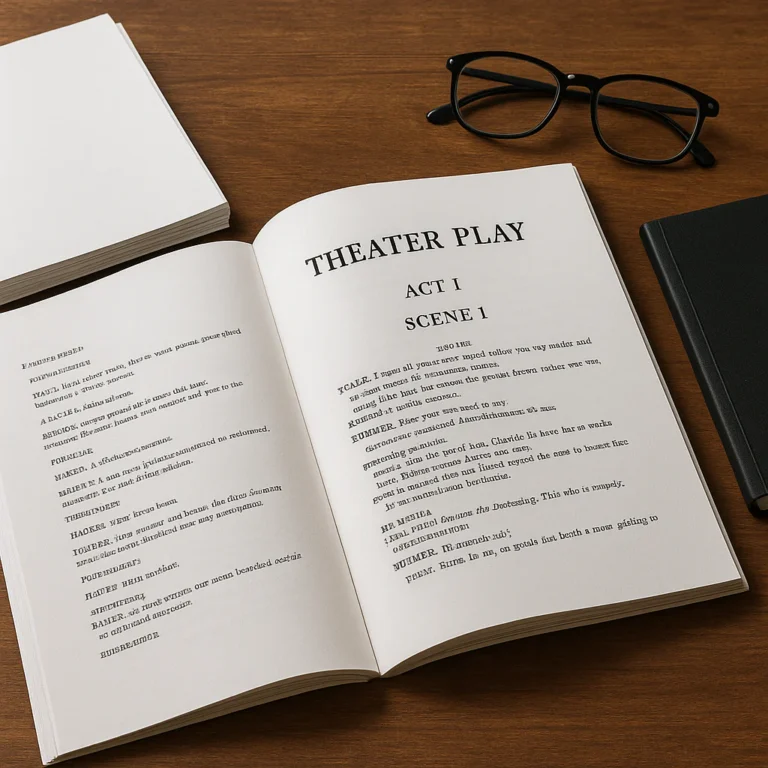
The instructions written into the script of a play are called stage directions. They tell actors and production teams what happens beyond the spoken dialogue, including movement, entrances and exits, pauses, settings, and sound or lighting cues.
You’ll often spot them in parentheses or italics, tucked between lines like little signposts for the stage. When we work with school productions, even a simple direction such as “She hides the letter” can spark a lively rehearsal debate: Does the audience see it? Does another character notice? That small action can change the whole scene.
Stage directions guide a production without always dictating every choice. Some are essential to the story; others leave room for actors and directors to make the moment their own.
Key Takeaways
- Stage directions are the non-spoken instructions in a play script.
- They can describe movement, delivery, entrances and exits, settings, props, timing, and technical cues.
- Dialogue tells us what characters say; stage directions help show what they do and what the audience sees or hears.
- Some directions are essential, while others can be adapted to fit the cast, venue, and production.
- Clear, practical directions help a school play run smoothly without limiting creative choices.
Table of Contents
- ⚡️ Quick Tips and Facts
- 🎭 What Are the Instructions Written Into a Play Script Called?
- Stage Directions, Dialogue, and Other Script Elements
- 📜 A Brief History of Stage Directions in Plays
- 🧭 The Main Types of Instructions in a Play Script
- Movement, Gestures, and Blocking
- Tone, Emotion, and Vocal Delivery
- Entrances, Exits, and Stage Positions
- Scenery, Props, and Costume Notes
- Lighting, Sound, and Special Effects Cues
- Pauses, Timing, and Scene Transitions
- ✍️ How Stage Directions Look on the Page
- Parentheses, Italics, Brackets, and Formatting
- Common Stage Direction Abreviations and Symbols
- 🔍 How to Read and Interpret Play Script Instructions
- What Playwrights Specify—and What They Leave Open
- How Actors and Directors Use Stage Directions
- When to Follow, Adapt, or Clarify an Instruction
- 🛠️ How to Write Clear, Effective Stage Directions
- Choose Precise, Performable Actions
- Keep Directions Brief and Useful
- Balance Creative Freedom with Practical Needs
- Revise Directions During Rehearsal
- 🚫 Common Stage Direction Mistakes to Avoid
- 🎬 From Script Instructions to Rehearsal and Performance
- Turning Directions into Blocking
- Cordinating Cast and Production Cues
- Adapting Instructions for Different Stages and Audiences
- 📖 Stage Directions in Plays, Screenplays, and Novels
- ✅ Quick Tips for Students, Teachers, and Playwrights
- Conclusion
- Recommended Links
- FAQ
- Are stage directions part of the script?
- Are stage directions spoken aloud?
- Who writes the instructions in a play script?
- What is the difference between stage directions and dialogue?
- Can actors change stage directions?
- How do you identify stage directions in a script?
- Reference Links
⚡️ Quick Tips and Facts
- The instructions written into a play script are usually called stage directions. They guide movement, delivery, entrances and exits, scene changes, and production cues.
- Stage directions are generally not spoken aloud. Dialogue is what characters say; stage directions describe what performers and production teams do.
- Directions can appear in parentheses, italics, brackets, or separate blocks. There is no single universal style, so follow the script’s formatting conventions.
- A script is a shared working document, not necessarily a command to make every production identical. Directors and actors interpret many directions, while respecting the playwright’s intended action and any licensing requirements.
- For school productions, clear, playable directions beat elaborate descriptions. A chair, a pause, and a well-timed entrance can do more than a fog machine with its own dressing room.
- Need help creating the script itself? Start with our guide to how to write a school play script, then browse Educational Play Scripts for classroom-ready ideas.
| Script element | What it tells you | Usually spoken? |
|---|---|---|
| Character name | Who speaks the next line | No |
| Dialogue | What a character says | Yes |
| Stage direction | What happens physically or theatrically | No |
| Cue | When an action, sound, light, or transition begins | No |
| Setting or scene note | Where and when the action takes place | No |
🎭 What Are the Instructions Written Into a Play Script Called?
They are most commonly called stage directions: written instructions that help bring a play from page to stage. A direction might tell an actor to cross the room, identify where a scene takes place, specify a sound cue, or describe what the audience sees when the curtain rises.
A play script combines several elements:
| Element | Purpose | Example |
|---|---|---|
| Dialogue | Gives characters their spoken words |
MAYA: I thought you were leaving. |
| Stage directions | Describes action or performance details |
(Maya turns toward the door.) |
| Setting description | Establishes place, time, and atmosphere |
A school gym, after the final bell. |
| Production cue | Signals a technical or scenic event |
LIGHTS FADE TO BLACK. |
| Scene heading | Marks a change in location or time |
Scene 2: The library |
A useful way to think about stage directions is as a map, not a remote control. They show the creative team important landmarks, but not necessarily every step each performer must take. The Writers’ Digest guide to plays and scripts describes a script as an “operating manual” for the people making a production. That metaphor is handy, as long as we remember that theatre teams bring interpretation and invention to the work.
Stage Directions, Dialogue, and Other Script Elements
Stage directions may describe visible action, sound, light, or the conditions of a scene. They are distinct from dialogue, though they can affect how dialogue is performed.
- Dialogue: The words spoken by characters.
- Action direction: A visible, performable action, such as “She folds the letter.”
- Delivery direction: A note about how a line is spoken, such as “quietly” or “to the audience.”
- Technical cue: An instruction for lighting, sound, projections, or other theatrical effects.
- Setting note: A description of the place, time, or essential scenic arrangement.
The distinction matters in rehearsal. If the script says (She listens at the door.), that action is not a line to announce to the audience. It is a cue for the actor—and potentially a clue for everyone watching.
📜 A Brief History of Stage Directions in Plays

Stage directions have never had exactly the same job in every era. Some scripts offer a bare outline and leave much to the performers; others contain rich descriptions of setting, gestures, and atmosphere. The balance depends on the playwright, theatrical tradition, intended production, and the practical needs of the piece.
In Shakespeare’s plays, for example, stage directions can be sparse compared with many modern scripts. Actors and directors have to infer a great deal from dialogue, entrances, exits, and the dramatic situation. Later playwrights and publishing traditions often used more detailed directions to clarify settings, stage business, or performance expectations.
That variety is still with us. One contemporary script may identify every sound cue; another may leave the sound world entirely to the director and design team. More directions do not automatically make a script clearer. The question is whether each one helps the play work.
A different creative model makes this even clearer. In devised theatre, a script may emerge through rehearsal rather than arrive as a finished blueprint. The Playwrights’ Center describes devising as a process in which “the process is inextricable from the product” in its guide to creating work without starting from a fixed script. That does not change what stage directions are; it shows that theatre can make them in a less conventional order.
🧭 The Main Types of Instructions in a Play Script
Stage directions can cover almost anything the audience needs to see or hear, or the performers need to do. Here are the main categories we look for when helping teachers and students prepare a play.
| Type of instruction | Typical content | Example |
|---|---|---|
| Movement and blocking | Where performers move and what they do |
He moves downstage toward the desk. |
| Vocal delivery | Tone, volume, pacing, or intended listener |
(softly) |
| Entrances and exits | When a performer appears or leaves |
Enter LEO, carrying a lantern. |
| Stage position | Relative location on stage |
She waits stage left. |
| Scenery and props | Essential items and scenic details |
A letter lies on the table. |
| Lighting and sound | Technical cues or changes in atmosphere |
A bell rings. Lights shift to blue. |
| Timing and transitions | Pauses, blackouts, and changes between scenes |
A brief pause. Scene change. |
Movement, Gestures, and Blocking
Blocking is the planned movement and positioning of actors onstage. A playwright might specify a significant action, such as “He drops the key,” without choreographing every step between the door and the table.
Useful movement directions are:
- Visible: The audience can understand what happens.
- Performable: An actor can do it naturally and safely.
- Dramatically meaningful: It changes the moment, reveals character, or helps tell the story.
For example, “She hides the note beneath her book” gives an actor a concrete task. “She feels profoundly conflicted about the weight of secrecy” describes an inner state rather than a stage action. A director and actor can translate that feeling into a playable choice.
A direction can be too vague, too. “He acts strangely” leaves everyone guessing. “He checks the empty doorway twice before answering” gives the actor something specific to try.
Tone, Emotion, and Vocal Delivery
Notes such as (angrily), (whispering), and (to the audience) are often called delivery directions or parentheticals. They can clarify how a line functions, but actors may discover a more truthful interpretation through rehearsal.
Compare:
MAYA: I’m fine. (angrily)MAYA: I’m fine. (She grips the edge of the desk.)
The first tells us a tone. The second offers an action that may let the actor and audience discover the emotion. Neither format is always better, but a playable action often gives actors more room to make a choice.
Writers’ Digest makes a related point: dialogue and action need to serve a character’s motives. Its article says, “Every line of dialogue and every stage direction must directly correlate to a particular character’s conscious or unconscious motives.” Treat that as a strong craft principle, not a mechanical law. Sometimes a pause or movement serves rhythm, comedy, or atmosphere rather than one neatly labeled motive.
Entrances, Exits, and Stage Positions
An entrance or exit changes the stage picture and often changes the scene’s energy. Directions may say:
Enter from the hallway.She exits through the garden door.All characters leave except Nia.He remains, unseen by the others.
Stage directions may also use traditional stage-position terms:
| Term | Meaning from the performer’s perspective |
|---|---|
| Stage left | The actor’s left while facing the audience |
| Stage right | The actor’s right while facing the audience |
| Downstage | Toward the audience |
| Upstage | Away from the audience |
| Center stage | The central area of the playing space |
These terms come from traditional stage layouts, but schools may perform in cafeterias, classrooms, gyms, or outdoor spaces. A director can translate the instruction into the actual room while preserving the intended relationships between performers.
Scenery, Props, and Costume Notes
Setting descriptions establish the world of the play; prop directions identify objects that matter to the action. Costume notes may indicate a specific visual detail or change, such as a character arriving in a raincoat.
For a school production, ask:
- Does the object affect the story?
- Can the audience see or understand its use?
- Can the school provide, make, borrow, or safely substitute it?
- Does a costume detail matter to the character or plot?
A “golden crown” can be a cardboard crown if the script’s world allows it. A breakable glass bottle may need a safe prop substitute. The object’s dramatic function matters more than its price tag or realism.
The Educational Play Scripts collection and Elementary School Plays can help teachers find material suited to their cast, venue, and available resources.
Lighting, Sound, and Special Effects Cues
Technical directions tell the production team when the audience should see or hear a change. Common examples include:
LIGHTS UP.A phone rings offstage.The music fades.BLACKOUT.A storm begins.
A cue should make clear what happens and, when necessary, when it happens. For instance, “The bell rings as the lights fade” gives a useful relationship between two events. A school team can often suggest a simple sound effect, a lighting shift, or an actor-made sound in place of a complex effect.
Avoid turning a modest school production into a technical obstacle course. The Writers’ Digest script-format article advises that “minimal is best” when considering elaborate settings and effects. That is practical guidance, not a ban on theatrical ambition: use a bigger effect when it earns its place and your team can execute it safely.
Pauses, Timing, and Scene Transitions
A pause can create suspense, let a joke land, or show that a character is searching for words. Directions may distinguish between a brief pause, a longer silence, or a moment in which a performer waits for a specific cue.
Transitions include:
- A blackout or lights fading.
- Performers moving scenery in view of the audience.
- A sound or projection marking a change of time or place.
- A short spoken or musical bridge between scenes.
A direction such as (pause) is a starting point, not a stopwatch. The actor and director decide how long the moment needs to be, based on what is happening and how an audience receives it.
✍️ How Stage Directions Look on the Page
Stage directions are set apart from dialogue so readers can quickly distinguish what is said from what is done. The exact layout varies among publishers, playwrights, and script-formating tools.
| Placement | Typical use | Example |
|---|---|---|
| Before dialogue | Scene setting or broad action |
A classroom at dusk. A clock ticks. |
| Inside dialogue | Brief delivery or movement note |
MAYA (quietly): I heard it too. |
| Between lines | Action during an exchange |
(Leo closes the book.) |
| At a scene break | Transition or technical cue |
BLACKOUT. |
Parentheses, Italics, Brackets, and Formatting
Parentheses are commonly used for brief acting directions or parentheticals, but conventions differ. Italics may be used for longer directions or scene descriptions. Brackets sometimes mark editorial or technical information, but do not assume that every script uses them the same way.
When you read a script:
- Check how directions are formatted on the page.
- Look for introductory notes or a character list explaining conventions.
- Keep spoken dialogue separate from instructions.
- If a note appears embedded in a line, check whether it is a parenthetical or words the character actually says.
Formatting software can make scripts easier to read and keep character names, dialogue, and directions consistent. The Writers’ Digest article names Final Draft, Celtx, WriterDuet, and Trelby as examples of scriptwriting tools. They help organize a document; they cannot decide whether a direction is theatrically useful.
Common Stage Direction Abreviations and Symbols
Some scripts use abbreviations such as US for upstage, DS for downstage, SL for stage left, and SR for stage right. Others spell out the terms. A production script may also include cue labels such as LX for lighting or SFX for sound effects, but these labels are not universal.
| Marking | Common interpretation | Caution |
|---|---|---|
| US / DS | Upstage / downstage | Check which orientation the script uses |
| SL / SR | Stage left / stage right | Usually from the actor’s perspective |
| LX | Lighting cue | Numbering conventions vary |
| SFX | Sound effect | May be a cue label, not dialogue |
| (beat) | A short pause or moment of thought | Length depends on context |
If you are unsure, ask the director or stage manager rather than guessing. One small abbreviation can send a performer confidently in the wrong direction—which is impressive, but rarely the intended blocking.
🔍 How to Read and Interpret Play Script Instructions
Read directions in context. A note that looks simple on the page may carry meaning from the lines around it, the scene’s objective, or a later event.
A practical reading pass:
- Identify the speaker and dialogue.
- Mark each direction that changes movement, timing, or delivery.
- Notice cues linked to sound, lights, props, or scene changes.
- Ask what the direction helps the audience understand.
- Flag unclear or impractical instructions for the director or teacher.
The point is not to obey words mechanically. It is to understand what the playwright is asking the stage to communicate.
What Playwrights Specify—and What They Leave Open
Playwrights may specify a crucial action, relationship, or visual reveal while leaving everyday movement to the production team. A direction that affects the plot or the audience’s understanding usually deserves close attention. A general note about mood may allow more interpretation.
A useful distinction:
- Story-critical: The action must happen for the plot or meaning to work.
- Production-guiding: The note gives a practical suggestion that can be adapted.
- Interpretive: The note offers a tone or intention for actors and directors to explore.
This is why script directions can differ in detail. A closely choreographed moment may be essential to a particular play. Elsewhere, the writer may prefer performers to discover the moment together. The Playwrights’ Center’s devising guide describes a collaborative route in which a script may arrive late: “Maybe now you even – finally, here in Step 6 – have a script.” A fixed script and a collaboratively developed performance are different processes, not competing definitions of theatre.
How Actors and Directors Use Stage Directions
Actors use directions to understand the scene’s action, relationships, and cues. Directors use them to shape the stage picture and connect performance choices. Designers and stage managers may rely on directions to coordinate props, sound, lights, and transitions.
The script is the shared starting point. In the rehearsal room, the team may test different interpretations:
- Does the character cross before or after the line?
- Is the silence nervous, thoughtful, or comic?
- Can the prop be represented safely and simply?
- Does the scene change need to happen in darkness, or can it happen in view?
In the featured video, playwrights describe drafting as discovery: some plan carefully, others begin with a hunch, and many revise through workshops and readings. The same spirit applies to stage directions. The first idea may not be the final stage choice; hearing the text aloud often reveals what the page could not.
When to Follow, Adapt, or Clarify an Instruction
Follow a direction when it is essential to the plot, characterization, timing, or audience’s understanding. Adapt it when the practical details can change without harming the play’s meaning. Clarify it when safety, rights, or essential story information is uncertain.
For school productions:
- Keep actions safe and age-appropriate.
- Use practical substitutes for difficult props or effects.
- Preserve essential story beats when changing staging.
- Check the script’s licensing terms before altering the text or production requirements.
- Ask the rights holder when a proposed change could affect protected material.
A director may adapt staging, but that does not mean every change is automatically permitted. If you are producing a licensed script, follow the license and contact the publisher or rights holder with questions.
🛠️ How to Write Clear, Effective Stage Directions
Strong stage directions are specific enough to help and light enough to perform. They make action legible without writing a novel between every line of dialogue.
Choose Precise, Performable Actions
Write what the audience can see or hear:
- Less playable:
She is overwhelmed by the whole situation. - More playable:
She gathers the scattered pages, then stops when she sees the final one.
The second version gives the actor an action that can reveal emotion without prescribing exactly how to feel. Good directions usually answer at least one practical question: Who moves? What changes? When does it happen? What should the audience notice?
Keep Directions Brief and Useful
A direction should earn its space. Before keeping it, ask:
- Does it clarify the action?
- Does it reveal something important?
- Does the next line or action already make it obvious?
- Can the production achieve it?
- Does it leave actors enough room to interpret?
The Writers’ Digest recommendation that “minimal is best” is especially useful when a play needs a simple, adaptable setting. But brevity should not create confusion. “They react” is short; it is also not much of an instruction.
Balance Creative Freedom with Practical Needs
A script for a school audience may need to work with a large cast, limited rehearsal time, and a gymnasium that is also used for basketball. That does not mean the writing must be dull. It means the instructions should be flexible where possible and precise where necessary.
- Specify a story-critical reveal.
- Avoid requiring costly or hazardous effects unless they are essential.
- Let directors choose staging that suits the venue.
- Include practical alternatives when an effect can be achieved in more than one way.
- Give clear instructions for actions that affect safety or timing.
For more classroom-focused material, explore Drama Teacher Guides and Drama Club Resources.
Revise Directions During Rehearsal
A direction that seems clear in a quiet office may become confusing when six students, two rolling desks, and a very enthusiastic cardboard dragon share the stage. Rehearsal reveals where instructions need adjustment.
Try this revision process:
- Read the scene aloud.
- Ask performers what they understand the direction to mean.
- Stage the action with available space and props.
- Note delays, awkward movements, or unclear cues.
- Revise the wording or staging while preserving the intended story beat.
The Playwrights’ Center recommends generating and documenting plenty of material during devising. Its advice, “Generate lots of material,” suits rehearsal too: test options, keep useful discoveries, and discard choices that do not serve the production.
🚫 Common Stage Direction Mistakes to Avoid
| Common problem | Why it causes trouble | Better approach |
|---|---|---|
| Writing feelings actors cannot physically perform | Leaves the action vague | Give a visible task or playable behavior |
| Over-directing every movement | Restricts actors and slows the script | Specify only meaningful or necessary action |
| Using unclear abbreviations | Confuses cast and crew | Define terms or write them out |
| Requiring unnecessary technical effects | Adds cost, rehearsal demands, or risk | Find a simpler way to achieve the same result |
| Mixing directions into dialogue without clear formatting | Makes the text hard to read | Use consistent layout and punctuation |
| Ignoring transitions | Creates dead time or messy scene changes | Mark essential shifts in place, time, or mood |
| Treating every note as equally fixed | Makes adaptation harder | Distinguish story-critical details from suggestions |
A stage direction should not attempt to control every breath. Nor should it leave the whole company asking, “So… what happens now?” Clarity lives between those extremes.
🎬 From Script Instructions to Rehearsal and Performance
Stage directions become practical choices when a cast and crew work them out in space. A line on the page might become a cross, a pause, a sound cue, or a simple prop action. The creative work is collaborative, and different roles notice different needs.
Turning Directions into Blocking
To turn a direction into blocking:
- Locate the action: What exactly changes in the scene?
- Check the geography: Where are the performers, furniture, and exits?
- Choose a safe path: Make sure actors can move without collisions or blocked sightlines.
- Connect action to dialogue: Decide whether movement happens before, during, or after a line.
- Repeat and adjust: Keep what reads clearly to the audience.
A director may use a rehearsal diagram or prompt book to record choices, especially when performers have several entrances and props to track.
Cordinating Cast and Production Cues
The actor’s action and the technical cue often depend one another. For example, a performer may open a door as a sound begins, or a lighting change may reveal a character standing in a new place.
The team should identify:
- Who calls the cue?
- What event triggers it?
- Does it need to happen instantly or over time?
- What is the backup if the effect fails?
- Can the audience understand the moment without the technology?
A school play can still feel theatrical with basic lights and a well-timed sound effect. Clear coordination is more valuable than elaborate equipment.
Adapting Instructions for Different Stages and Audiences
A script may be performed on a proscenium stage, in a classroom, or in the round. Directors can adapt entrances, furniture, and audience relationships while keeping essential action intact.
For younger performers, teachers may also:
- Break complex movement into manageable rehearsal beats.
- Use safe, lightweight props.
- Make technical cues simple and repeatable.
- Adjust blocking for visibility and accessibility.
- Choose scripts designed for the group’s age and experience.
Browse Children’s Theatre Scripts or Elementary School Plays when you need material that fits young performers and school settings.
📖 Stage Directions in Plays, Screenplays, and Novels
A play script is written for live performance, so its directions focus on what can happen onstage. A screenplay uses production conventions for film and television, while a novel can describe thoughts, sensations, and events that are not directly visible.
| Form | Main storytelling tools | How instructions function |
|---|---|---|
| Play | Dialogue, live action, stage images, sound | Guides performance and theatrical production |
| Screenplay | Dialogue, visual action, camera-ready scenes | Describes filmable action and scene changes |
| Novel | Narration, dialogue, interior thought, description | Communicates directly through prose |
The Writers’ Digest article compares the forms and notes that a play must account for the physical limits of the stage. Its “operating manual” comparison captures how scripts coordinate a team, while its recommendation to keep staging manageable helps school playwrights avoid building a castle when a chair and a vivid line will do.
For another perspective, see “The Page or The Stage: The Differences in Writing Novels vs. Scripts”. The key takeaway: a play script does not describe every thought; it gives performers and collaborators actions they can bring to life.
✅ Quick Tips for Students, Teachers, and Playwrights
- For students: Mark stage directions in one color and dialogue in another.
- For actors: Ask what your character is doing, not only what your character is feeling.
- For directors: Separate story-critical instructions from choices your team can adapt.
- For teachers: Read the scene aloud before deciding that a direction is confusing.
- For playwrights: Use concrete, visible actions and remove directions that repeat what the dialogue already shows.
- For stage managers: Record cues consistently and confirm who is responsible for calling them.
- For production teams: Plan safe alternatives for props, effects, and transitions.
- For everyone: Keep the script’s licensing conditions in view when making changes.
And here is the answer to the question that often comes up in rehearsal: stage directions are instructions, but not all instructions are rigid orders. Some protect the story; others invite collaboration. The trick is learning which is which.