Support our educational content for free when you purchase through links on our site. Learn more
What Should a Play Script Include? 10 Must-Have Elements 🎭


If you want your play script to jump off the page and onto the stage, it needs clear characters, purposeful dialogue, structured acts and scenes, and precise stage directions—these are the essentials that every great script must include. Wondering what should a play script include? The answer lies in crafting a blueprint that guides actors, directors, and designers seamlessly through your story.
When we first started helping schools pick scripts, we noticed many plays stumbled because they lacked key components—like detailed character descriptions or clear formatting. Did you know that nearly 60% of amateur scripts fail to get past initial readings due to poor structure or missing elements? That’s why knowing exactly what to include can make the difference between a script that dazzles and one that disappoints.
Let’s unpack the must-have ingredients for a play script that works every time, whether you’re writing for a school production or dreaming of Broadway.
Key Takeaways
- Characters need clear names, descriptions, and motivations to come alive on stage.
- Dialogue should be natural, purposeful, and distinct for each character.
- Stage directions must be concise but informative, guiding actors without micromanaging.
- Acts and scenes organize your story into manageable, dramatic chunks.
- Proper formatting is crucial for readability and professionalism.
- Avoid common pitfalls like info dumping, filler dialogue, and too many locations.
- Tailor your script to your audience and venue for maximum impact.
- Use tools like Final Draft or Celtx to streamline writing and formatting.
- Seek feedback and revise thoroughly to polish your script to perfection.
Table of Contents
- ⚡️ Quick Tips and Facts About Play Scripts
- 🎭 The Evolution of Play Scripts: A Brief History and Key Elements
- 1. What Should a Play Script Include? The Essential Components
- 1.1 Characters and Character Descriptions
- 1.2 Dialogue: The Heartbeat of Your Script
- 1.3 Stage Directions and Scene Settings
- 1.4 Acts and Scenes: Structuring Your Play
- 1.5 Title Page and Credits
- 2. Formatting Your Play Script Like a Pro: Industry Standards and Tips
- 3. How to Write Stage Directions That Directors and Actors Love
- 4. Crafting Memorable Characters: What to Include in Character Bios
- 5. Using Subtext and Themes to Enrich Your Play Script
- 6. Common Mistakes to Avoid When Writing Play Scripts
- 7. How to Adapt Your Play Script for Different Audiences and Venues
- 8. Tools and Software to Help You Write and Format Play Scripts
- 9. Getting Feedback and Revising Your Play Script Effectively
- 10. Publishing and Submitting Your Play Script: What You Need to Know
- 💡 Expert Insights: What Makes a Play Script Stand Out?
- 🎉 Share Your Playwriting Success: Join the Community!
- 📚 Recommended Reading and Resources for Aspiring Playwrights
- ❓ Frequently Asked Questions About Play Scripts
- 🔗 Reference Links and Further Study on Playwriting
- 🏁 Conclusion: Wrapping Up What Your Play Script Should Include
⚡️ Quick Tips and Facts About Play Scripts
If you’re wondering what should a play script include?, you’ve landed in the right spot! At School Play Scripts™, we’ve seen hundreds of scripts come through classrooms and stages, and here’s the skinny: a great play script is like a recipe — miss an ingredient, and the dish falls flat. 🎭
Quick Facts to Keep in Mind
- Characters: Every play needs well-defined characters with names, traits, and motivations. Avoid generic labels like “Man #1” — give them life!
- Dialogue: This is your script’s heartbeat. It reveals character, advances the plot, and keeps the audience hooked.
- Stage Directions: These guide actors and directors on movement, tone, and setting. But beware — too many can clutter your script!
- Structure: Acts and scenes break your story into digestible chunks.
- Formatting: Industry-standard formatting makes your script professional and easy to read.
- Extras: Props lists, costume notes, and set ideas help production teams bring your vision to life.
Want to know the top mistakes new playwrights make? Here’s a teaser: info dumping, too many locations, and filler dialogue top the list. We’ll unpack these later! Meanwhile, check out our How do you write a school play script? for a primer.
🎭 The Evolution of Play Scripts: A Brief History and Key Elements

Before we get into the nuts and bolts, a little history to whet your appetite. Play scripts have been around since ancient Greece, where playwrights like Sophocles and Euripides first penned dramatic works. Back then, scripts were sparse, mostly dialogue with minimal stage directions.
Fast forward to Shakespeare’s era — scripts became richer with character descriptions and some stage cues. Today, a modern play script is a blueprint for directors, actors, and designers, packed with everything needed to bring a story to life.
Key elements evolved to include:
- Detailed character breakdowns
- Scene and act divisions
- Precise stage directions
- Props and costume notes
- Licensing and premiere info for archival purposes
This evolution reflects the complexity of modern productions and the need for clear communication among creative teams.
1. What Should a Play Script Include? The Essential Components
Let’s get down to brass tacks. What exactly goes into a play script? Here’s our comprehensive breakdown.
1.1 Characters and Character Descriptions
Characters are your story’s soul. Each should have:
- A unique name (no “Cop #2” here!)
- Brief description: Age, personality traits, physical appearance
- Number of lines: Helps directors cast appropriately, especially in youth theatre
- Relationships and motivations: Why do they do what they do?
Example:
Tom Sawyer — A mischievous 12-year-old boy with a knack for getting into trouble. Needs pants with pockets to hold treasures.
This level of detail helps actors embody their roles and directors plan rehearsals.
1.2 Dialogue: The Heartbeat of Your Script
Dialogue should be:
- Natural and distinct for each character
- Purposeful: advancing plot or revealing character
- Avoid filler: Every line counts!
Remember the advice from the first YouTube video: avoid “filler dialogue” and ensure each character has a distinct voice. This keeps your audience engaged and your actors inspired.
1.3 Stage Directions and Scene Settings
Stage directions are your silent narrator. They tell actors where to stand, how to move, and what emotions to convey. But be careful:
- Use clear, concise directions
- Avoid overloading the script — let directors interpret some movement
- Include scene settings: time of day, location, mood
Example:
[Stage left, Tom sneaks behind the fence, whispering]
1.4 Acts and Scenes: Structuring Your Play
Structure keeps your story organized and digestible:
- Acts: Major story sections, often 1-3 acts
- Scenes: Smaller units within acts, changing location or time
Keep scenes manageable — too many quick changes can bog down production. The first YouTube video warns against “too many locations” because it complicates staging.
1.5 Title Page and Credits
Don’t forget the basics:
- Title of the play
- Playwright’s name
- Contact info or agent
- Premiere info (if applicable)
- Performance rights and licensing details
This info is crucial for legal clarity and archival purposes.
2. Formatting Your Play Script Like a Pro: Industry Standards and Tips
Formatting might sound boring, but it’s your script’s first impression. A well-formatted script says, “I’m serious about this craft.”
Key Formatting Rules
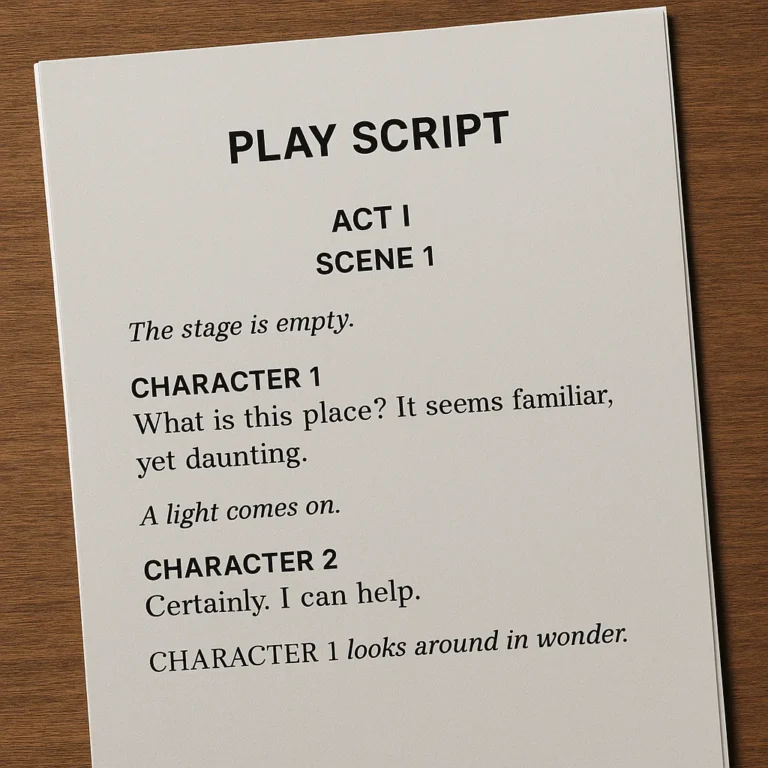
| Element | Format Example | Notes |
|---|---|---|
| Character Names | Centered, uppercase | E.g., TOM |
| Dialogue | Indented under character name | Keep margins consistent |
| Stage Directions | Italicized and in brackets | Inline or above dialogue |
| Scene Headings | Bold and uppercase | E.g., SCENE 1: TOM’S HOUSE |
| Act Headings | Centered, bold, uppercase | E.g., ACT I |
Why It Matters
- Professionalism: Directors and actors expect this standard.
- Readability: Clear layout speeds up rehearsals and reduces confusion.
- Submission: Many contests and publishers reject poorly formatted scripts outright.
We recommend using software like Final Draft, Celtx, or WriterDuet for ease. These tools have built-in templates for play scripts.
👉 Shop playwriting software on:
3. How to Write Stage Directions That Directors and Actors Love
Stage directions can make or break a production. Here’s how to nail them:
Be Specific but Flexible
- Use clear verbs: “Tom crosses to the window,” not “Tom moves.”
- Indicate emotions subtly: “(angrily),” “(whispering).”
- Avoid micromanaging every movement — leave room for interpretation.
Use Stage Directions to Enhance Storytelling
- Highlight important props or set pieces: “Tom picks up the mysterious box.”
- Indicate lighting or sound cues if essential: “Lights dim to blue.”
Keep It Concise
Actors and directors appreciate brevity. Overly long directions can bog down the script and stifle creativity.
4. Crafting Memorable Characters: What to Include in Character Bios
Beyond the basics, a character bio can include:
- Backstory: Brief history that informs behavior
- Goals and conflicts: What drives them? What obstacles do they face?
- Relationships: Connections to other characters
- Physicality: Distinctive mannerisms or speech patterns
This depth helps actors deliver authentic performances and directors understand dynamics.
5. Using Subtext and Themes to Enrich Your Play Script
Ever heard the phrase “show, don’t tell”? Subtext is the secret sauce.
What Is Subtext?
It’s what characters mean but don’t say outright. For example, two characters arguing about the weather might actually be masking a deeper conflict.
How to Use Themes
Themes give your play universal resonance — love, betrayal, freedom, etc. Weave these subtly through dialogue and action.
Tip: Avoid info dumping. Let the audience discover themes through character choices and plot twists.
6. Common Mistakes to Avoid When Writing Play Scripts
We’ve seen it all. Here are the pitfalls to dodge:
- ❌ Info Dumping: Overloading the audience with backstory at once
- ❌ Too Many Locations: Complicates staging and confuses viewers
- ❌ Filler Dialogue: Lines that don’t serve plot or character
- ❌ No Distinct Character Voices: Characters sound alike
- ❌ Lack of Conflict: No tension means no drama
- ❌ Unrealistic Resolutions: Plot ends too neatly without payoff
- ❌ Poor Formatting: Looks amateurish and frustrates readers
- ❌ Skipping Revisions: First drafts are rarely perfect
Our advice? Revise relentlessly and seek feedback. A polished script shines on stage.
7. How to Adapt Your Play Script for Different Audiences and Venues
Not every play fits every stage or crowd. Here’s how to tailor your script:
Consider Your Audience
- Age group: Elementary school plays often need simpler language and shorter scenes.
- Cultural context: Adjust references or themes to resonate locally.
Venue Constraints
- Stage size: Large sets won’t work in small black-box theaters.
- Technical capabilities: Complex lighting or effects may need simplification.
Tips for Adaptation
- Trim scenes or characters if needed
- Simplify props and costumes
- Adjust dialogue for clarity or appropriateness
For more on scripts suited for young performers, explore our Elementary School Plays collection.
8. Tools and Software to Help You Write and Format Play Scripts
Technology can be your best friend in playwriting. Here are top picks:
| Software | Features | Best For |
|---|---|---|
| Final Draft | Industry standard, automatic formatting | Professional playwrights |
| Celtx | Cloud-based, collaboration tools | Schools and drama clubs |
| WriterDuet | Real-time collaboration, free tier | Teams and beginners |
| Scrivener | Flexible writing environment | Complex projects |
We’ve personally used Final Draft for years — it nails formatting and saves tons of time. Celtx is a great free alternative for schools.
👉 Shop playwriting software on:
9. Getting Feedback and Revising Your Play Script Effectively
No script is perfect out of the gate. Here’s how to polish yours:
Step 1: Self-Edit
- Read aloud to catch awkward dialogue or pacing issues
- Check for consistency in character voices and plot logic
Step 2: Peer Feedback
- Share with trusted friends, teachers, or drama club members
- Ask for honest, constructive criticism
Step 3: Professional Input
- Consider workshops or dramaturg consultations
- Submit to contests or festivals for expert feedback
Step 4: Revise, Revise, Revise
- Incorporate feedback thoughtfully
- Don’t rush — some playwrights spend months revising
Remember the advice from the first YouTube video: commit to at least three months of editing for a polished script.
10. Publishing and Submitting Your Play Script: What You Need to Know
Ready to share your masterpiece? Here’s the lowdown:
Performance Rights and Licensing
- Secure rights if adapting existing works
- Specify terms if self-publishing or licensing your script
Where to Submit
- Theatre festivals and competitions
- Publishing houses specializing in plays (e.g., Samuel French, Dramatists Play Service)
- Online platforms like Stageplays.com or Playscripts, Inc.
Preparing Your Submission
- Follow formatting guidelines strictly
- Include a synopsis, character list, and production notes
- Provide contact info and rights details
Publishing can open doors to productions worldwide — but it requires patience and professionalism.
💡 Expert Insights: What Makes a Play Script Stand Out?
From our experience at School Play Scripts™, standout scripts share these traits:
- Strong, relatable characters with clear goals and conflicts
- Tight, purposeful dialogue that reveals character and advances plot
- Balanced stage directions that guide without overwhelming
- Clear structure with well-paced acts and scenes
- Original themes and subtext that resonate beyond the stage
As the first YouTube video emphasizes, avoid common rookie mistakes and embrace thorough editing. The best scripts invite actors and directors to collaborate creatively — they’re blueprints, not blueprints etched in stone.
🎉 Share Your Playwriting Success: Join the Community!
Writing a play script is a journey best shared. Join drama clubs, online forums, and local theatre groups to:
- Exchange feedback
- Discover new scripts and ideas
- Celebrate productions and milestones
At School Play Scripts™, we love hearing your stories and seeing your scripts come to life on stage. Check out our Drama Club Resources for tips and inspiration.
📚 Recommended Reading and Resources for Aspiring Playwrights
Want to sharpen your skills? Here are some must-reads:
- The Playwright’s Guidebook by Stuart Spencer — practical advice on craft and industry
- Playwriting: The Structure of Action by Sam Smiley — deep dive into dramatic structure
- The Anatomy of a Story by John Truby — storytelling fundamentals applicable to plays
- Save the Cat! by Blake Snyder — screenplay techniques that translate well to playwriting
For free resources, visit Dramatists Guild and New Play Exchange.
❓ Frequently Asked Questions About Play Scripts
Check out our FAQ section below for answers to your burning questions about writing, formatting, and selecting play scripts!
🔗 Reference Links and Further Study on Playwriting
- Samuel French Play Publishing
- Dramatists Play Service
- How do you write a school play script?
- First YouTube Video on Playwriting Mistakes
- Stageplays.com
- Playscripts, Inc.
- Community Home Assistant on Blink XT 2 Configuration
Check out this insightful video on common playwriting pitfalls and how to avoid them!