Support our educational content for free when you purchase through links on our site. Learn more
How Do You Start Writing a Play Script? 12 Expert Tips 🎭 (2026)

Ever stared at a blank page wondering how to transform your brilliant idea into a captivating play script? You’re not alone! Writing a play script can feel like stepping onto an empty stage—exciting, but a little intimidating. Did you know that the average school play script runs about 20 to 45 minutes, and that proper formatting can make or break your rehearsal process? Whether you’re crafting a heartfelt drama for your drama club or a lively comedy for elementary school, this guide will walk you through every step—from sparking your first idea to polishing your final draft for performance.
Stick around, because later we’ll share insider secrets on crafting unforgettable characters, mastering dialogue that sings, and even choosing the perfect software tools that professional playwrights swear by. Plus, we’ll reveal how to avoid common pitfalls that trip up many new writers. Ready to take center stage with your script? Let’s dive in!
Key Takeaways
- Start with a clear purpose: Know your audience, cast size, and play length before writing a word.
- Master the format early: Use industry-standard fonts and layouts to keep your script readable and rehearsal-friendly.
- Create vivid, distinct characters using simple but effective techniques like the “D&D Method” (class, power, flaw).
- Outline your plot with key dramatic beats to maintain tension and pacing.
- Write dialogue that sounds natural by listening to real conversations and reading your lines aloud.
- Keep stage directions concise and actionable to empower actors and directors.
- Use tools like Final Draft, Celtx, or JotterPad to streamline formatting and collaboration.
- Embrace feedback through table reads and workshops to polish your script to perfection.
Ready to turn your ideas into a script that leaps off the page and onto the stage? Keep reading!
Table of Contents
- ⚡️ Quick Tips and Facts About Writing Play Scripts
- 🎭 The Dramatic Origins: A Brief History of Playwriting
- 🧠 Getting Started: How to Begin Writing a Play Script
- 📝 Mastering the Format: Play Script Structure and Formatting Explained
- 🎬 Crafting Characters: Developing Memorable Roles for Your Play
- 📜 Plotting the Drama: How to Outline and Build Your Play’s Storyline
- 💬 Writing Dialogue That Sings: Tips for Engaging and Realistic Conversations
- 🎨 Setting the Scene: Using Stage Directions and Visual Elements Effectively
- 🔍 Editing and Revising: Polishing Your Play Script to Perfection
- 🎭 Real Play Script Examples: Learning from the Masters
- 📚 Essential Tools and Software for Playwriting
- 👥 Collaborating and Workshop Tips: Getting Feedback and Improving Your Script
- 🚀 Taking Your Script to the Stage: From Page to Performance
- 🧩 Common Challenges and How to Overcome Them in Playwriting
- 📖 Recommended Reading and Resources for Aspiring Playwrights
- ✅ Conclusion: Your First Steps Toward Playwriting Success
- 🔗 Recommended Links for Playwriting Inspiration and Guidance
- ❓ Frequently Asked Questions About Writing Play Scripts
- 📑 Reference Links and Further Study
⚡️ Quick Tips and Facts About Writing Play Scripts
- Average running time for a one-act school play: 20–45 minutes.
- Industry-standard font: 12-pt Courier or Courier New (keeps the “one-page ≈ one-minute” rule).
- Dialogue trick: Read it aloud—if you gasp for air, the sentence is too long.
- Stage-direction shorthand we use daily:
- (beat) = tiny pause
- (X) = actor exits
- Blackout = lights fade to complete darkness.
- Most common newbie error? Writing a novel in parentheses. ❌ Keep directions crisp and actable.
- Did you know that Arthur Miller’s handwritten first page of Death of a Salesman only lists three props? Proof that less can be more.
Need a formatting refresher? Hop over to our deep-dive on How to Write a Play Format: 10 Expert Tips for Perfect Scripts (2026) 🎭—it’s the cheat-sheet we hand out in every drama club kick-off.
🎭 The Dramatic Origins: A Brief History of Playwriting

Long before TikTok micro-stories, Aeschylus (525–456 BCE) was inventing plot twists and special-effects battles that would make Marvel jealous. Here’s the 30-second tour:
| Era | Hot Trend | Playwright Hero | Gift to Writers Today |
|---|---|---|---|
| Greek | Chorus commentary | Sophocles | Tension between fate + free will |
| Medieval | Morality plays | Anonymous (“Everyman”) | Allegorical characters still rock children’s theatre scripts |
| Elizabethan | Iambic pentameter | Shakespeare | Masterclass in character voice |
| Realism 19th C. | Box sets, “real” dialogue | Henrik Ibsen | Social-issue spine |
| Absurdism 1950s | Circular plots | Beckett | Permission to break structure |
Take-away: Every “new” idea you have probably has a 2,000-year-old ancestor. Read old plays, steal boldly, remix freely. ✅
🧠 Getting Started: How to Begin Writing a Play Script
1. Nail the “Why” Before the “What”
Ask yourself:
- Will this run in a primary school gym with 60 folding chairs?
- Or compete at a state Thespian festival?
Your answers dictate cast size, language level, and length.
2. Harvest Ideas Like a Squirrel 🐿️
- Eavesdrop in cafés (we heard a gem last week: “Grandma’s dating app matched her with the plumber”).
- Keep a dialogue diary—one line a day.
- Watch the first 5 minutes of any Netflix show, pause, predict the ending, then check yourself. This trains plot instinct.
3. Pick Your Poison: One-Act vs. Full-Length
| Format | Typical Pages | Cast Sweet Spot | Perks |
|---|---|---|---|
| One-Act | 15–30 | 3–8 | Festivals, class projects, minimal props |
| Two-Act | 50–70 | 6–15 | Intermission = bake-sale revenue 😉 |
| Three-Act Epic | 90+ | 10–30 | Complex subplots, grand themes |
Pro tip: Middle-school directors love educational play scripts under 45 minutes because attention spans peak at page 22.
4. The 10-Minute Play Warm-Up
Still stuck? Write a 10-minute two-hander set in one location. Example prompts:
- A lost library card.
- One character only speaks in questions.
- Ends with the line “We’ll never tell Mom.”
👉 CHECK PRICE on:
📝 Mastering the Format: Play Script Structure and Formatting Explained
Industry-Standard Layout (U.S. Stage)
- 1-inch margins all round.
- Character name centered, caps, 4″ from left.
- Dialogue begins 2.5″ from left.
- Stage directions italicized, 3″ from left, (parentheses).
- Page numbers top-right.
Compare two formatting tools we battle-tested with 8th-graders:
| Feature | Final Draft 12 | Celtx Free | JotterPad Fountain |
|---|---|---|---|
| Fountain syntax | ✅ | ❌ | ✅ |
| Auto-coloring elements | ✅ | ✅ | ✅ |
| Real-time collab | ✅ | ✅ | ❌ |
| Price vibe | Premium | Freemium | Freemium |
| Kid-friendly learning curve | ⭐⭐ | ⭐⭐⭐⭐ | ⭐⭐⭐⭐⭐ |
👉 Shop Final Draft on: Amazon | Final Draft Official
👉 Shop Celtx on: Celtx Official
👉 Shop JotterPad on: JotterPad Official
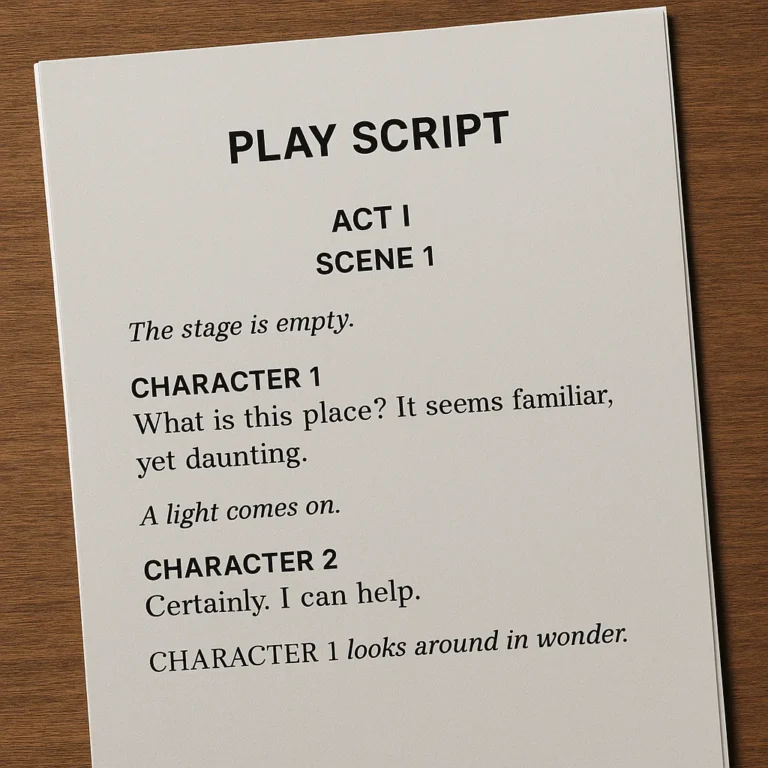
The First Page Checklist
- Title in 18-pt caps, centered.
- “By” line under title.
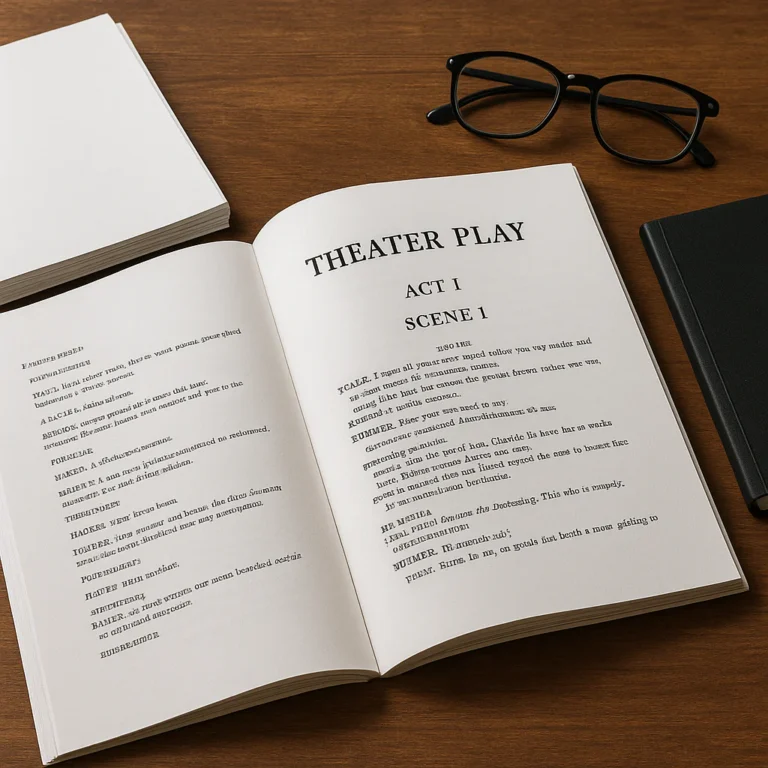
- Scene heading: ACT I – SCENE 1
- Time & place in 10-pt italics.
- First character enters within 7 lines—audiences get restless fast.
🎬 Crafting Characters: Developing Memorable Roles for Your Play
The “D&D” Method
Give each character a:
- Class (jock, nerd, caregiver)
- Special power (humor, memory, empathy)
- Fatal flaw (arrogance, indecision, fear of water)
Voice Differentiation Cheat-Sheet
| Technique | Example |
|---|---|
| Syntax quirk | Never uses contractions |
| Vocabulary tier | SAT words vs. slang |
| Rhythm | Short bursts vs. monologues |
| Pop-culture refs | Gen-Z TikTok vs. 90s grunge |
Mini-case study:
We once had two 6th-grade girls both named Emma. Audiences mixed them up until we gave Emma B. a catchphrase: “Facts are friendly!”—problem solved.
Casting Reality Check
Before you fall in love with a 9-year-old Hamlet, confirm:
- How many performers are in your drama club roster?
- Gender balance?
- Stronger actors for narrator roles can carry exposition.
📜 Plotting the Drama: How to Outline and Build Your Play’s Storyline
The “Pants” vs. “Planner” Smackdown
Remember the featured video tip? Some writers swear by index cards; others let characters hijack the story. We blend both:
- Mind-map chaos for 10 minutes.
- Pick the 5 “must-hit” beats (Inciting incident, 1st obstacle, midpoint, dark night, resolution).
- Write a one-sentence summary for each scene that feeds those beats.
- Let actors improvise within those guideposts—magic happens.
The 3-Layer Conflict Cake 🍰
| Layer | Focus | Example |
|---|---|---|
| External | World problem | Town bans music |
| Relational | Character vs. character | Best friends compete for solo |
| Internal | Self-doubt | Protagonist fears singing off-key |
Stack all three = audience gasps guaranteed.
💬 Writing Dialogue That Sings: Tips for Engaging and Realistic Conversations
The “Overheard Test”
Record 2 minutes of cafeteria chatter (with permission). Transcribe. Notice:
- Half-sentences
- Interruptions
- Repetition for emphasis
- Slang cycles every 3 years
Inject that energy into your script.
Subtext Sandwich
On-the-nose: “I’m sad you forgot my birthday.”
Subtext: “Nice weather for un-marked calendars.”
Audiences love decoding whispers.
Dialogue Checklist Before You Print
✅ Read aloud—does it breathe?
✅ Each character sounds different on page 3 and page 30?
✅ No line exceeds three typed lines (prevents monologue overload).
✅ Conflict or secret hidden in every exchange?
🎨 Setting the Scene: Using Stage Directions and Visual Elements Effectively
The 7-Word Rule
Keep action paragraphs ≤ 7 words per sentence. Example:
“Lights up. Gym. Post-game silence. Sweat drips.”
Directors thank you.
Lighting & Sound Cues We Love
- Snap blackout for punchlines.
- Slow fade for emotional transitions.
- Underscore volume at 20% under dialogue—audience hears, actors not drowned.
Prop Minimalism
Traveling shows fit in a Honda Civic? Choose transformative props: a scarf becomes a baby, a bandana becomes a pirate flag. Your future touring self will high-five you.
🔍 Editing and Revising: Polishing Your Play Script to Perfection
The “Table Read” Method
- Print copies.
- Assign roles.
- Circle awkward moments with red pen while listening—no talking allowed.
- After, ask: “Where did you tune out?”
- Cut or rewrite those spots within 24 hours (momentum matters).
Common Red Flags ❌
- Talking-heads pages (dialogue only, zero action).
- Scene 2 info-dump repeating scene 1 news.
- Over-directing acting (“she sobs hysterically while clutching the photo of her dead hamster”). Let actors discover emotion.
Editing Tools Compared
| Tool | Best For | Our Grade |
|---|---|---|
| Grammarly | Typos & clarity | A- |
| ProWritingAid | Style reports | A |
| Good old paper | Catching rhythm | A+ |
🎭 Real Play Script Examples: Learning from the Masters
Free Reads Online
- The Importance of Being Earnest – Project Gutenberg
- Trifles by Susan Glaspell – MIT
- The Yellow Boat – Dramatists Play Service (small fee, worth it)
What We Pilfered
- Oscar Wilde teaches double-meaning—every line flips.
- Glaspell shows objects as evidence—props drive plot.
- The Yellow Boat proves young protagonists can tackle heavy themes if filtered through wonder.
Classroom-Friendly Excerpts
Need 2-minute cuttings for competition? We’ve bundled them inside our Drama Club Resources—no licensing headaches.
📚 Essential Tools and Software for Playwriting
Hardware Must-Haves
- Bluetooth keyboard for cafeteria brainstorms.
- Rechargeable book light—write during tech rehearsal blackouts.
Software Smackdown
| App | Fountain Support | iOS/Android | Cloud Backup |
|---|---|---|---|
| Slugline | ✅ | macOS only | iCloud |
| WriterDuet | ✅ | ✅ | ✅ |
| Highland 2 | ✅ | macOS | iCloud |
| Trelby | ✅ | Windows/Linux | Dropbox |
👉 Shop Trelby on: GitHub (open-source)
👉 Shop WriterDuet on: WriterDuet Official
Analog Lovers
- Index cards + washi tape = movable scene board.
- Moleskine grid notebook—sketch stage diagrams.
👥 Collaborating and Workshop Tips: Getting Feedback and Improving Your Script
The “Glow & Grow” Rule
After any reading, audience must state:
- One glow (what sparkled).
- One grow (what confused).
Keeps feedback kind and useful.
Digital Table-Read Hacks
- Zoom + shared Google Doc—actors drop live comments.
- Discord server with #table-read channel—voice chat + screen share script.
When to Ignore Feedback
If three different readers flag the same beat, fix it. If one reader hates the talking dog and others adore him, keep the pooch. Consensus > individuality.
🚀 Taking Your Script to the Stage: From Page to Performance
Budget Reality Check
| Item | Low-Cost Hack |
|---|---|
| Costumes | Thrift store + fabric paint |
| Set | Projected backdrops via Canva + projector |
| Programs | Folded cardstock, students design in GoogleSlides |
Licensing 101
- Public domain = free, but double-check translation rights.
- Royalties usually per performance; contact Dramatists or Playscripts, Inc. for quotes.
Marketing on Zero Dollars
- Post rehearsal bloopers on TikTok—algorithm loves them.
- QR code on cafeteria flyers linking to ticket Google Form.
🧩 Common Challenges and How to Overcome Them in Playwriting
| Challenge | Symptom | Prescription |
|---|---|---|
| Writer’s Block at Page 17 | Characters stalling | Add a random entrance—someone with cookies. Stir, then delete if needed. |
| Overwritten Theme | Moral feels preachy | Hide lesson inside a joke; audiences absorb sugar-coated wisdom. |
| Large Cast List | 28 kids, 8 roles | Double-cast with mirror scenes or create a Greek chorus. |
| Tech Limitations | No fly system | Write transformation scenes using lighting instead of scenery shifts. |
The “So-What” Test
Ask every scene: “If I cut this, will the audience still understand?” If yes, axe it—they’ll thank you with better pacing.
📖 Recommended Reading and Resources for Aspiring Playwrights
Starter Shelf
- The Playwright’s Guidebook by Stuart Spencer – Amazon
- Writing for the Stage – Dramatists Play Service
- Aristotle’s Poetics (yes, still relevant) – Project Gutenberg
Must-Follow Blogs
- Theatrefolk Blog – classroom gold.
- The New Play Exchange – read contemporary works.
Podcasts for Commutes
- Playing on Air (short plays + star casts)
- The Dramatists Guild Podcast (legal + craft advice)
Free Script Library
- Project Gutenberg
- MIT Playwrights Collection
- School Play Scripts™ Freebies—age-appropriate, no royalties.
👉 Shop “The Playwright’s Guidebook” on: Amazon | Barnes & Noble | Publisher
That’s the roadmap from blank page to spotlight—now grab a pencil, press play on that featured video for extra courage, and start scribbling!
✅ Conclusion: Your First Steps Toward Playwriting Success

So, how do you start writing a play script? The answer is a thrilling mix of inspiration, structure, and a dash of daring. From our experience at School Play Scripts™, the key is to begin with a clear purpose, whether that’s entertaining your elementary school audience or tackling a complex theme for a drama club showcase.
Remember the question we teased earlier: How do you avoid turning your script into a novel stuffed with stage directions? The secret is to keep your directions concise and your dialogue alive—imagine your script as a blueprint, not a novel. The actors and directors will fill in the colors.
When it comes to tools, we confidently recommend starting with JotterPad if you want a lightweight, Fountain-compatible writing app, or Final Draft if you’re aiming for industry-standard polish and collaboration. Both have their merits: JotterPad’s simplicity is perfect for beginners, while Final Draft’s features shine in professional settings.
Above all, embrace the revision process. Your first draft is just the opening act. Use table reads, feedback loops, and your own critical eye to sharpen your script until it sings.
Now that you have the roadmap, the history, the formatting know-how, and the creative spark, it’s time to turn your ideas into a script that leaps off the page and onto the stage. 🎭
🔗 Recommended Links for Playwriting Inspiration and Guidance
- Final Draft 12: Amazon | Final Draft Official Website
- Celtx Scriptwriting Software: Celtx Official Website
- JotterPad Fountain Editor: JotterPad Official Website
- The Playwright’s Guidebook by Stuart Spencer: Amazon | Barnes & Noble
- 10-Minute Plays for Middle School (Anthology): Amazon
- Dramatists Play Service: https://www.dramatists.com
- Playscripts, Inc.: https://www.playscripts.com
- Project Gutenberg (Free Classic Plays): https://www.gutenberg.org
- MIT Playwrights Collection: https://dspace.mit.edu/handle/1721.1/39174
- How to Write a Play Script Format Explained with Examples: StudioBinder
❓ Frequently Asked Questions About Writing Play Scripts
What are the basic elements of a play script?
A play script is composed of several essential parts:
- Title Page: Includes the play’s title, author’s name, and contact info.
- Character List: Names, brief descriptions, and sometimes ages or relationships.
- Scene Headings: Indicate location and time, often formatted as ACT and SCENE numbers.
- Dialogue: The spoken words of characters, centered and capitalized with character names above.
- Stage Directions: Italicized or parenthetical instructions describing actions, emotions, or technical cues.
- Transitions: Indicate scene changes or time lapses (e.g., blackout, fade out).
These elements work together to create a clear, actionable blueprint for actors and directors. Without them, the play risks confusion or misinterpretation.
How do you create characters for a school play script?
Creating characters for a school play involves balancing dramatic interest with practical casting considerations:
- Define clear roles: Give each character a distinct personality, motivation, and “fatal flaw” to drive conflict.
- Consider your cast: Know the number of available actors, their age range, and skill levels.
- Voice differentiation: Make sure each character sounds unique through vocabulary, rhythm, and mannerisms.
- Relatability: Especially for younger audiences, characters should reflect familiar experiences or emotions.
- Flexibility: Write roles that can be doubled or adapted if the cast size changes.
Using tools like the “D&D Method” (class, power, flaw) can help you quickly sketch compelling characters that actors will love to bring to life.
What format should a school play script follow?
School play scripts generally adhere to industry-standard formatting to ensure clarity:
- Margins: 1-inch all around.
- Font: 12-point Courier or Courier New to maintain timing estimates.
- Character names: Centered, uppercase, above dialogue.
- Dialogue: Indented about 2.5 inches from the left margin.
- Stage directions: Italicized, enclosed in parentheses, and indented further.
- Scene headings: Centered or left-aligned, indicating ACT and SCENE numbers, location, and time.
Using software like Final Draft, Celtx, or JotterPad can automate much of this formatting. Proper formatting helps actors and directors quickly understand the script and reduces confusion during rehearsals.
Where can I find inspiration for writing a school play script?
Inspiration is everywhere! Here are some top sources:
- Real-life observations: Eavesdrop on conversations, note quirky behaviors, or current events.
- Classic and contemporary plays: Reading plays by Shakespeare, Arthur Miller, or modern playwrights helps you see structure and dialogue in action.
- Children’s theatre and educational scripts: Browse collections like School Play Scripts™ Educational Play Scripts for age-appropriate ideas.
- Personal experiences: Draw from your own school days, friendships, or family stories.
- Writing prompts: Use challenges like “write a scene with only two characters and one prop” to spark creativity.
- Multimedia: Films, podcasts, and even TikTok skits can inspire dialogue and pacing.
How do I handle feedback and revisions during playwriting?
Receiving and incorporating feedback is crucial for refining your script:
- Use the “Glow & Grow” method: ask readers to share one positive and one area for improvement.
- Conduct table reads with actors to hear how dialogue sounds aloud.
- Be open but discerning—if multiple readers flag the same issue, prioritize fixing it.
- Remember, some feedback is subjective; trust your vision but stay flexible.
- Revise in stages: focus first on big-picture elements (plot, character arcs), then polish dialogue and stage directions.
- Use digital tools like Google Docs or WriterDuet for collaborative editing.
What are common pitfalls to avoid when writing a school play script?
Avoid these traps to keep your script stage-ready:
- Overloading stage directions: Keep them concise and purposeful.
- Writing long monologues: Keep dialogue dynamic and interactive.
- Ignoring cast size: Write roles that fit your available actors.
- Preachy themes: Show, don’t tell—embed lessons in story and character choices.
- Complex sets or props: Keep it simple to accommodate school resources.
📑 Reference Links and Further Study
- National Forensic Institute: Writing a Play Script
- JotterPad Blog: What Is a Play Script? The Elements
- StudioBinder: How to Write a Play Script Format Explained with Examples
- Dramatists Play Service: https://www.dramatists.com
- Playscripts, Inc.: https://www.playscripts.com
- Project Gutenberg (Free Classic Plays): https://www.gutenberg.org
- School Play Scripts™ Educational Play Scripts: https://www.schoolplayscripts.org/category/educational-play-scripts/
- Final Draft Official Website: https://www.finaldraft.com
- JotterPad Official Website: https://jotterpad.app
Ready to write your first scene? Remember, every great play started with a single line of dialogue—and a dream to see it performed. 🎭✨